
Book launch social media plan: five posts
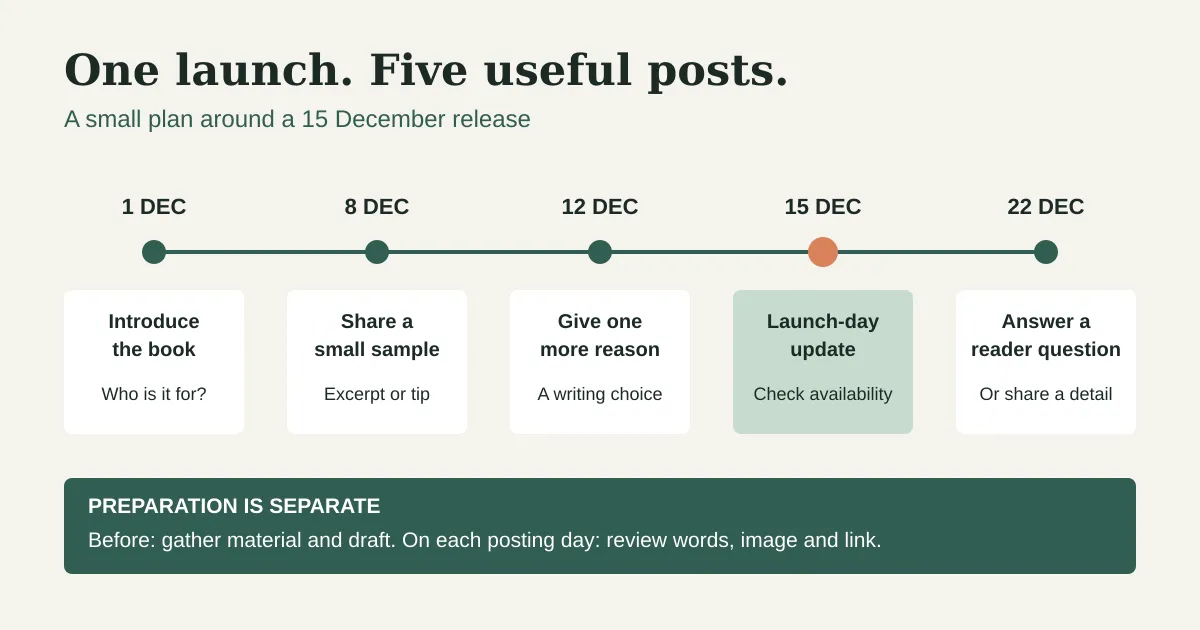
A book launch social media plan can be as small as five posts: introduce the book, share a sample, give another reason to read, announce checked availability, and follow up with something useful. Put those posts around your release date, and keep drafting and link checks on a separate preparation list. If five feels like too much, keep the introduction, launch-day update and follow-up.
Build your book launch social media plan around one date
Start with the release date you can confidently share and one social account you already use. Decide where an interested reader should go: a book page, an available sample, or a working preorder page. Before preorders open, a book-details page is enough; don't write an order invitation that has nowhere to send someone.
Gather a small set of material before assigning posting dates:
- The title, release date and formats you can confirm.
- A cover image you may use, plus a plain description for its alt text.
- One spoiler-safe fiction passage or one accurate nonfiction idea.
- One sentence about who might enjoy or use the book.
- A destination link you have opened yourself.
You don't need advance reviews, reader photos or a launch team to use this plan. Add those only when you actually have them and permission to share them.
Longer campaigns are another option. Jenn Hanson-dePaula's 12-week pre-publication plan starts with readers' interests before making the book more visible; SocialMate's launch plan proposes twenty messages across three phases. The five-post sequence below is a smaller starting point, not a claim that five is the best number for every launch.
Five posts for a 15 December release
Say you're releasing The Mapmaker's Guest, a quiet mystery about a cartographer who finds a room on a map that doesn't exist in her house, on 15 December 2026. The book, passage and captions below are invented to show the sequence. Replace them with details from your own book.
Treat these dates as optional posting days. Write the drafts beforehand; a dated draft still needs your review before it goes out.
1 December: introduce the book and its reader
Give someone unfamiliar with your work enough context to decide whether they're interested. A title and countdown alone don't tell them what they'll be reading.
A room appears on Mara's map, but not in her house. The Mapmaker's Guest is my new quiet mystery for readers who enjoy strange houses, old secrets and a puzzle that unfolds slowly. It releases on 15 December. Read about the book through the book-details link in my profile.
Pair the post with the cover. If preorders are open, replace the last sentence with an accurate preorder invitation. If your platform supports a useful clickable link in the post, put the checked destination there instead of sending readers to your profile.
8 December: let readers try a small piece
Choose a passage that makes sense without explaining the entire plot. Include enough context to show why you've chosen it, then stop before the reveal.
Mara has measured every room in the house. This is the moment the map disagrees with her:
“She counted the windows again. Five on the outside. Six on the page. In the narrow room behind the sixth, someone had drawn a chair.”
The Mapmaker's Guest releases on 15 December. The opening-page sample is on the book page linked in my profile.
Only promise a longer sample if readers can actually open one. Otherwise end with the title and release date. Copy the passage from the final book text rather than from an older draft.
12 December: share a writing choice
Give the book a different point of entry instead of repeating the announcement. Explain a decision a reader can appreciate without knowing the story's solution.
I kept the strange room in The Mapmaker's Guest almost empty. A chair felt more unsettling to me than a room full of clues: it suggests someone is expected. That small choice shaped the mystery. The book releases on 15 December.
An image of your own marked-up manuscript can fit here, but check the visible page for spoilers and private notes. The cover also works; you don't need a new graphic for every caption.
15 December: say what's available and where
Open the destination on launch day before using “out now.” Name the formats that are available, rather than implying every edition is ready.
The Mapmaker's Guest is out today in ebook and paperback. If you enjoy a quiet mystery about an impossible room and the person who mapped it, you can find the book through the link in my profile. Thank you for following this story from draft to release.
Use that wording only if both formats are live. If the paperback is delayed, say the ebook is available and the paperback is still to come. Check that the profile link points to this book, not a previous release.
22 December: add something beyond “buy my book”
Answer a question you've genuinely received, or share a detail you haven't used yet. You can follow up without having reviews or sales figures to announce.
A detail from The Mapmaker's Guest: Mara labels rooms by how they feel to stand in, not just by their measurements. I liked the idea that a precise map could still be personal. When you remember a place from a novel, is it the layout or the atmosphere that stays with you?
If you have a real reader question, use it instead. Don't invent an exchange to make the book appear more talked about. A reader's message or photograph needs permission before you share it publicly.
For nonfiction, make the sample useful on its own
Keep the same five jobs, but replace story intrigue with a problem the book helps readers understand. The introduction names the reader's situation; the sample gives one usable idea; the writing-choice post explains why you included a method or chapter.
For a book about organizing family photographs, the sample could read:
Start with one envelope of photographs rather than the whole cupboard. Make a note of any names and dates you already know before you sort them. My book walks through this one-batch-at-a-time approach; it releases on 15 December.
Use that caption only if it matches your book's advice. On launch day, say who the guide is for and which formats are available. For the follow-up, answer one narrow question from the book, such as what to do with photographs you can't yet identify.
Keep three posts if time is short
Keep the introduction, checked launch-day announcement and one follow-up. Fold a short sample into the introduction if it helps readers understand the book. Leave out the writing-choice post first: it adds depth, but readers can understand the release without it.
If launch is less than a week away, begin now rather than squeezing the missed dates into a burst of posts. Publish an introduction when you're ready, then review the launch-day update and follow-up. You don't owe your audience a retrospective countdown.
Recheck what can change before each post
Separate reusable words from details that can go stale. Your description of the story may stay accurate while the date, preorder status, format availability or event information changes.
Before publishing:
- Open the exact link a reader will use. Check it on your phone as well.
- Read the caption against current book details. Remove placeholders and outdated availability claims.
- Inspect the image for tiny text, spoilers or private information, and add useful alt text where the platform supports it.
- Check the final post inside the destination account, including its link and line breaks.
If the release moves, pause any scheduled posts that mention the old date. Update the book page and profile link, revise the affected drafts, then give readers one clear date-change update. You can still share a passage or writing choice while the new date is being settled; leave the date out rather than guessing.
Keep the preparation list beside your drafts
AuthorSocials' free book launch checklist lets you choose a launch date, edit optional preparation and drafting steps, and copy or print the selected list without signup. You can also open editable launch-post starters within the checklist; the drafts remain yours to review and publish manually.
After the launch sequence, use the simple weekly content-ideas plan when you want to return to ordinary book and writing posts.