
Social media content ideas for authors: a simple week
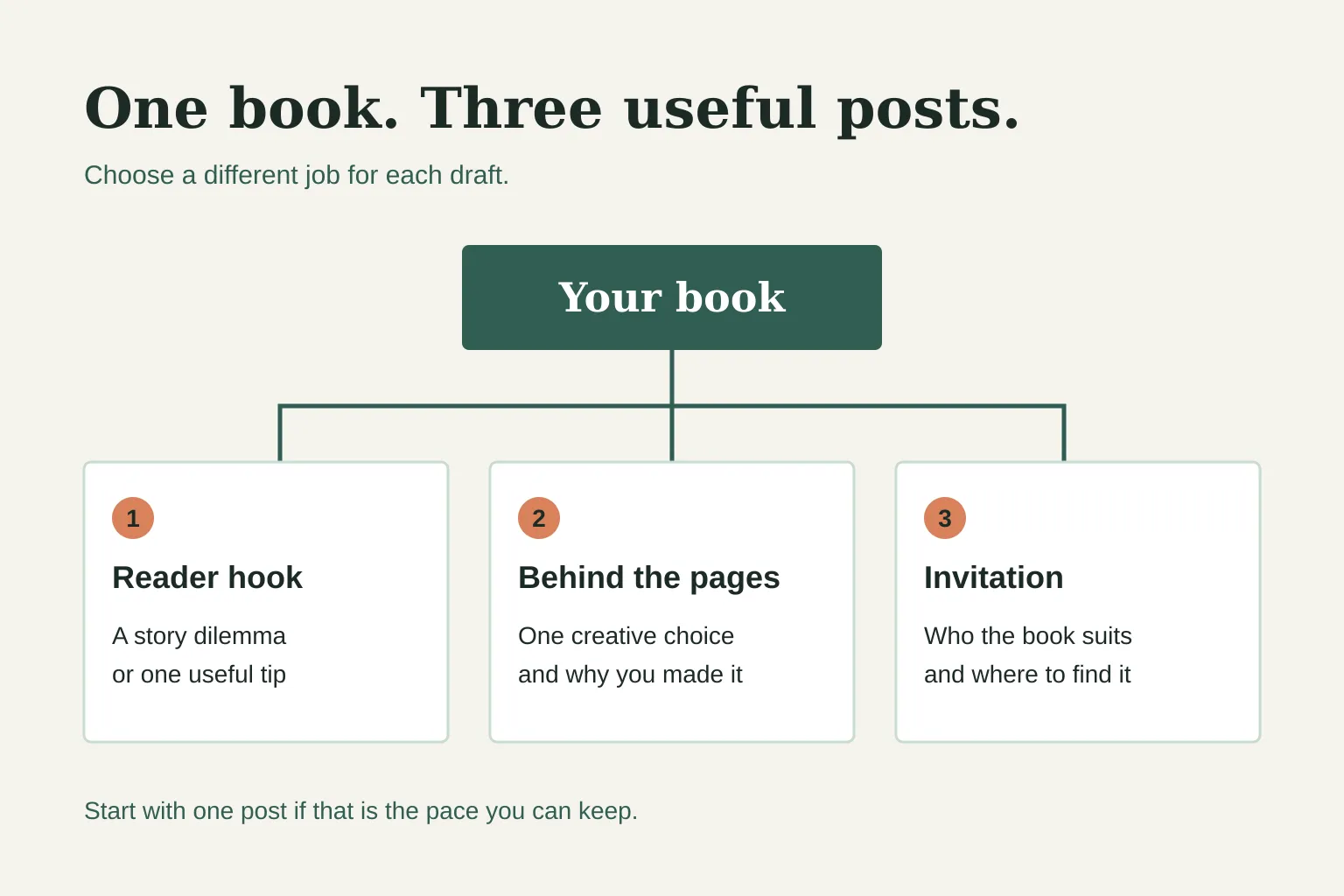
Social media content ideas for authors can come from three places: what readers will find in your book, the choices you made while writing it, and a clear invitation to read more. Choose one small detail for each post rather than retelling the whole book. Start with a reader question or useful tip today, then add a behind-the-pages post and a book invitation when you have room.
Choose social media content ideas for authors by the job they do
A post is easier to write when you know what you want a reader to take from it. Use this menu to choose a subject you can describe truthfully without extra research or a new photo shoot.
| Post idea | For a fiction author | For a nonfiction author |
|---|---|---|
| A reader question | Ask about a spoiler-free dilemma: keeping a secret or telling a difficult truth. | Ask which part of a task is hardest: getting started or keeping track. |
| One detail from the book | Describe a sound, object or place that sets the mood. | Explain one small method a reader can try on its own. |
| A short excerpt | Share a few exact lines that show the voice without revealing a twist. | Share a brief passage that explains one idea clearly. |
| A choice behind the pages | Explain why you changed a scene's location or point of view. | Explain why a chapter uses a checklist, diagram or worked example. |
| A reading recommendation | Name a book you enjoyed and the specific quality you liked. | Recommend a book that approaches your subject from another useful angle. |
| An older-book invitation | Introduce the story by its genre, mood and spoiler-free premise. | Name the task the book helps with and what it actually covers. |
Choose the row with the most concrete detail available. If you have no excerpt ready, a real revision decision may be quicker. If your practical book needs several pages of context for a tip to be safe or useful, choose a structure decision instead.
For a larger inspiration bank, BookBub's 29 author content ideas include published examples of cover reveals, writing updates and other formats. You don't need to use every format to make a useful week.
Turn one book into three different posts
Try a reader hook, a behind-the-pages choice and an invitation. These give you three distinct subjects from the same book, so you aren't rewriting “my book is available” each time.
Here is a worked week for an imagined mystery, The Glasshouse Key, about a gardener who finds a locked room on an abandoned estate. The same week also shows how an imagined practical book, A Small Balcony Garden, could use the three jobs.
Monday: give readers something specific to respond to
Fiction draft:
Would you open a locked room if the key arrived with no explanation? In The Glasshouse Key, a gardener has to decide whether a forgotten room belongs to her employer's past—or should stay there.
Nonfiction draft:
Before adding another pot to a small balcony, sketch where the door opens and where you need to stand to water. That's the first layout step in A Small Balcony Garden. Which is harder in your space: fitting plants in or keeping them easy to reach?
The fiction post offers a choice without giving away the answer. The nonfiction post gives a complete, low-stakes action before asking a question. Neither needs a purchase link to make sense.
Wednesday: show one decision behind the book
Fiction draft:
I moved the first conversation in The Glasshouse Key from the kitchen to the greenhouse. I wanted the gardener to notice what had been neglected before anyone explained the estate's history. The setting let her start asking questions on her own.
Nonfiction draft:
I put the balcony layout exercise before the plant list in A Small Balcony Garden. I wanted readers to work out what they could comfortably reach before choosing what to grow. That order shaped the opening chapter.
Use a decision you really made. You can share the intention behind a revision without claiming that every reader will experience the scene exactly as you hoped.
Friday: help the right reader find the book
Fiction draft:
If you enjoy quiet mysteries with overgrown gardens and family secrets, The Glasshouse Key follows a gardener whose new job comes with an unexplained key. Read the opening chapter on my book page: [add your book-page link].
Nonfiction draft:
Planning a garden on a small balcony? A Small Balcony Garden starts with a layout exercise, then covers container choices and a simple care plan. See the contents and a sample chapter here: [add your book-page link].
Replace the bracketed text with a working destination and check that the promised chapter or contents are there. One clear next step is enough.
What can authors post when there is no new release?
Authors can share a detail from an older book, a genuine writing decision, a reading recommendation or a question connected to their subject. A new release isn't necessary for any of those posts. Give an older title context for someone discovering it for the first time: what kind of book it is, who might enjoy it and where to read more.
Revisit an older title with a different detail rather than manufacturing news. For practical nonfiction, reread the relevant section before sharing its guidance so the post reflects information you still stand behind.
Keep the plan small enough to use
Three posts are a planning option, not a posting requirement. If one post is all you want to make this week, choose it and leave the others for later.
Before you copy a draft to your social account, check:
- Is the detail true? Use exact excerpts and genuine writing choices. Don't add reviews, awards or reader reactions you don't have.
- Does it make sense to a new reader? Replace “she finally finds out” with enough spoiler-free context to understand the subject.
- Have you kept the important context? A practical tip should include the conditions that make it useful; a teaser should leave the plot's answer unrevealed.
- Is the next step ready? Test the link and remove leftover brackets. If you ask a question, leave yourself time to read replies.
After the week, note which subject produced a conversation you wanted to have and which draft took too much effort. Use that to choose next week's posts; you don't need to turn three posts into a verdict on your book.
If you'd like a starting draft, AuthorSocials has twelve free, editable book-post starters for fiction and nonfiction authors. Choose one, replace its brackets with true details, and copy your edited words to post yourself when you're ready.